Why Smoothing Fabric Shows More Texture in Photos Than in the Mirror
Quick Answer: A camera flattens depth and freezes a single instant, while a mirror gives you binocular depth and continuous motion that your brain averages. Direct or angled light also produces hard shadow edges that raise contrast on any surface variation, and phone lenses at close range exaggerate whatever is nearest the camera. The fabric performs identically in both — the imaging does not.
You did the mirror check from three angles and it looked exactly as it should. Then someone takes a photo and there are lines, ripples, and texture you’re certain weren’t there ninety seconds ago.

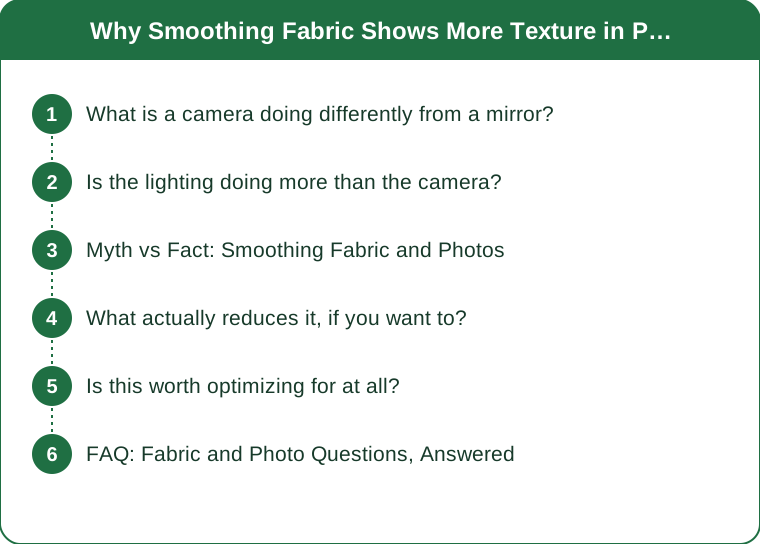
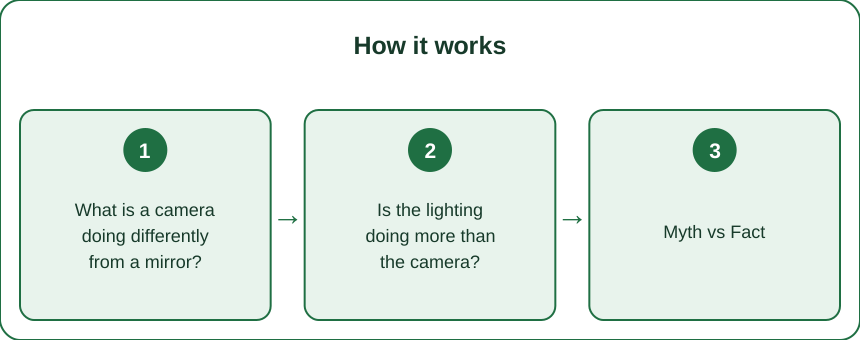
What is a camera doing differently from a mirror?
Four things at once, and they all push in the same direction.
It removes depth. Your eyes give you stereo vision, and your brain uses that to separate an actual contour from a shadow. A photo has no depth information, so a shadow and a shape become the same thing.
It freezes one instant. In the mirror you’re seeing continuous motion, and your brain averages across it. A photo captures whichever fraction of a second you happened to be mid-shift in.
It applies a lens. Phone cameras at close range have significant perspective distortion, magnifying whatever is closest to the lens.
It compresses tonal range. Cameras have far less dynamic range than your eye, so mid-tone gradations get pushed apart and subtle surface variation becomes visible contrast.
Is the lighting doing more than the camera?
Usually, yes. Light direction is the biggest single variable in whether a surface reads as smooth.
Overhead lighting — most bathrooms, most changing rooms — casts short, hard shadows downward and picks out every horizontal ripple. It’s the least flattering common lighting for fabric.
Direct flash does the opposite and flattens everything, which is why flash photos often look smoother than the mirror did.
Side lighting at a low angle is the harshest possible test. Raking light across a surface maximizes shadow length for any given variation, which is precisely the technique used to inspect surfaces for defects.
Diffuse, frontal light — a window on an overcast day, a large softbox — minimizes it. Most product photography uses exactly this, which is part of why garments look different on you than online.
The practical version: the same leggings in the same body position will read differently under a bathroom fixture, a window, and a phone flash. All three are real.
Myth vs Fact: Smoothing Fabric and Photos
Myth: If it shows in a photo, that’s what people actually see. Fact: People see you in stereo, in motion, from several feet away, under mixed light. A close-range still photo is a strictly harsher and less representative view.
Myth: Higher compression would fix it. Fact: Beyond a point, more compression creates new edges at the garment’s borders — a band that digs creates a harder line than the texture it smoothed. There’s an optimum, not a monotonic improvement.
Myth: Thicker fabric always photographs smoother. Fact: Thickness helps up to a point, but surface finish matters more. A matte, slightly textured face scatters light and hides variation; a shiny face reflects it and amplifies every contour.
Myth: The mirror is the accurate one. Fact: Neither is objective. The mirror is closer to how people perceive you in person, which is the more relevant standard for most purposes.

What actually reduces it, if you want to?
Choose matte over sheen. A matte face diffuses reflected light and is genuinely more forgiving under any lighting. Shiny or wet-look finishes photograph beautifully in controlled light and badly in overhead light.
Choose mid-tone and dark colors for photo-heavy contexts. Light colors show shadow gradation more; very dark colors compress it.
Check the waistband width. A wide band distributes pressure across a larger area and creates a gentler transition than a narrow one, which produces a single hard line.
Size correctly rather than down. Sizing down increases tension, which increases the border edge and makes the fabric shinier as it stretches. Both work against you.
Move the light, not the garment. If you’re taking photos, front-facing diffuse light from a window at eye height will do more than any wardrobe change.
Is this worth optimizing for at all?
That’s a genuine question worth asking rather than assuming.
A still photo under overhead light is close to a worst-case rendering of any fabric on any body. Building a wardrobe around performing well in that specific condition means optimizing for the harshest and least common way anyone actually sees you.
There’s also a mechanical limit. No fabric eliminates surface variation — it redistributes it. Compression moves tissue and creates a border somewhere; the question is only where the transition sits and how gradual it is.
Where it’s reasonable to optimize: if you’re photographed regularly for work, or you’re choosing something for an event you know will be photographed. Matte finish, correct size, wide band, and diffuse frontal light will genuinely get you most of the available improvement.
Where it isn’t: quietly concluding from a bad photo that the leggings failed. They didn’t — a camera and a ceiling light collaborated on an unusually severe test, and the mirror was giving you the more representative answer all along.
FAQ: Fabric and Photo Questions, Answered
Why do brand photos look so different?
Controlled diffuse lighting, a longer lens from further away, a chosen instant from many frames, and usually some retouching. It’s a different imaging setup, not a different garment.
Does a front camera or rear camera matter?
Yes. Front-facing cameras typically have wider lenses and lower quality sensors, so they exaggerate perspective and handle tonal gradation worse. A rear camera from six feet away is a far fairer test than a front camera at arm’s length.
Should I trust the fitting room mirror?
More than a phone photo, less than you’d like. Fitting rooms are usually overhead-lit, which is harsh. If you can, step out into diffuse or window light before deciding — that’s closer to how the garment will read in most of your life.
TL;DR:
- Cameras remove depth, freeze one instant, distort at close range, and compress tonal range.
- Overhead and raking light maximize shadow on any surface variation; diffuse frontal light minimizes it.
- Matte finishes, correct sizing, and wide waistbands help; sizing down actively hurts.
- The mirror is closer to how people actually perceive you than a close-range still photo is.
The fabric didn’t change between the mirror and the photo. The optics did — and a phone at arm’s length under a ceiling light is about the least generous way anything has ever been looked at. Judge it in the light you’ll be living in.
See It in Motion
Seen here: High Waist 8” Yoga Shorts — shop similar styles on bubblelime.com
Keep Reading
This article is for general informational and styling purposes only. Fit, sizing, and product availability may vary — check current details before purchasing.