Why Your Smoothing Legging Works in Photos From the Front and Not From the Side
Quick Answer: Smoothing fabric works by redistributing soft tissue sideways and inward, which flattens the outline you see head-on. From the side, that redistributed volume has to go somewhere — usually forward or up — and the profile shows it. Add the fact that side lighting reveals every surface transition that front lighting flattens, and a garment can genuinely perform well from one angle and poorly from another. This is physics, not a defect.
Most smoothing garments are designed, fitted and photographed frontally.
Which is why the profile is where they are most likely to disappoint.

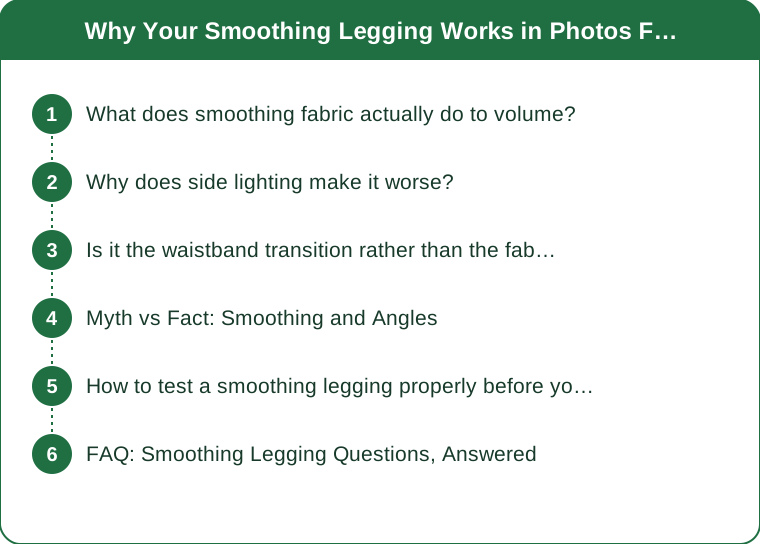
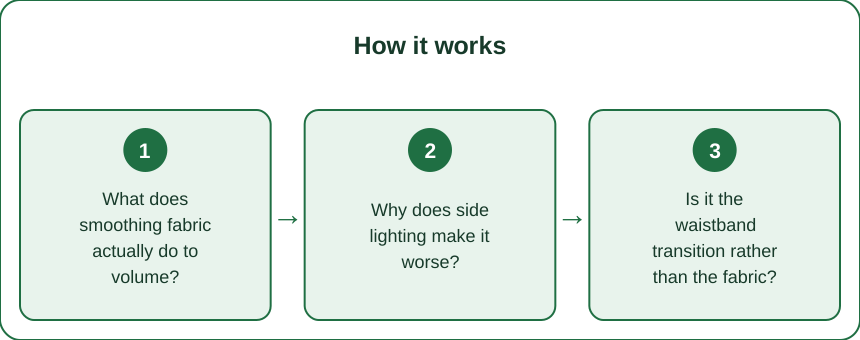
What does smoothing fabric actually do to volume?
It moves it. It does not remove it.
Compressive fabric applies inward pressure across a surface. Soft tissue under that pressure is displaced, and displaced tissue has to go somewhere — typically to the edges of the compressed zone, above it, or below it.
Viewed from the front, that redistribution is largely invisible. You are looking at a silhouette defined by the left and right outlines, and pulling volume inward from those outlines makes the shape narrower and smoother.
Viewed from the side, you are now looking at a completely different pair of outlines — front and back. Volume that was pulled in from the sides has to be accommodated somewhere, and part of it moves forward and backward, which is exactly the plane the profile shows.
This is not a flaw in a particular product. It is what compression does. Any garment that works by pressure rather than by structure will trade one plane against another to some degree.
Where the trade lands depends on the panel design. A garment with compression only across the front and sides will push volume backwards; one with a full circumference of even compression distributes more evenly and shows less in profile. This is genuinely visible on a hanger if you look for it — feel where the fabric is denser or doubled.
Why does side lighting make it worse?
Because it reveals surface geometry that front lighting hides, and this effect is large.
Frontal light falls evenly across a surface facing you, which minimises shadows and flattens texture. It is used in product photography for exactly that reason.
Side light rakes across a surface, and every transition — a seam, a waistband edge, a change in fabric density, a slight fold — casts a small shadow. Shadows read as lines. A profile photograph taken with a window to one side will show every one of them.
Three consequences worth knowing:
Mirrors mislead. Bathroom and bedroom mirrors are usually lit from above and in front, which is close to the flattering case. Your mirror check is not a neutral test.
Phone cameras exaggerate. A phone at close range introduces perspective distortion, and the auto-processing increases local contrast, which deepens exactly the shadows in question.
Gym lighting is the harshest case. Overhead spotlights create strong downward raking light, which is why so many people report a garment looking fine at home and wrong in a changing-room photo.
So before concluding the garment is at fault, it is worth checking whether you have compared it under the same conditions — which almost nobody does.
Is it the waistband transition rather than the fabric?
Very frequently, yes, and this is the most fixable version of the problem.
The profile view is the only angle that clearly shows the transition at the top edge of a legging. From the front, the waistband is a horizontal line across a flat plane. From the side, it is a step — and if the fabric is compressing below it and not above it, that step has a shadow under it.
The usual causes:
The rise is wrong for your torso. A waistband that lands at the widest point of your midsection creates the largest possible step. Moving it higher, above that point, or genuinely lower, below it, both reduce it. High-rise works for most people for exactly this reason.
The band is too tight relative to the leg fabric. A very firm band on a moderately compressive legging produces a pronounced boundary. Even compression through the band and the body of the garment shows far less.
The top is ending at the same place. A top hem that finishes exactly at the waistband doubles the line. Either tucking in or extending well past the band removes the coincidence, and this is a free fix that works immediately.
That last one is worth trying before you conclude anything about the legging. A large share of profile complaints are two garment edges landing at the same height, which reads as a single deep line and is entirely a styling issue.

Myth vs Fact: Smoothing and Angles
Myth: A good smoothing legging should look identical from every angle.
Fact: No compressive garment achieves this, because compression displaces rather than removes. What a good garment does is distribute the trade evenly instead of concentrating it in one place.
Myth: More compression gives a better result in profile.
Fact: Often the reverse. Higher compression displaces more volume, and that volume becomes more visible in the plane you are not compressing. Moderate, even compression frequently photographs better in profile than firm compression does.
Myth: Sizing down improves the smoothing.
Fact: Sizing down increases pressure and therefore increases displacement, usually making the profile worse while marginally improving the front view. It also increases the waistband step, which is the main thing you were trying to fix.
Myth: Seamless construction always looks smoother.
Fact: Seamless removes seam lines, which helps under thin fabrics. It also removes the structural panelling that distributes compression deliberately, which is what controls where the volume goes. Seamed garments often perform better in profile.
Myth: If it looks wrong in a photo, it looks wrong in person.
Fact: This is the assumption doing the most damage, and it is simply not true — a phone at arm’s length compresses perspective and boosts local contrast in a way that no human eye at conversational distance does, so the photo is a harsher and less accurate witness than the room is.
How to test a smoothing legging properly before you buy
Six steps, done in a fitting room, that test the angles nobody checks.
1. Turn sideways first, not last. Make the profile your primary check rather than your afterthought. If it passes in profile, it will pass from the front.
2. Sit down and stand up before judging anything. Compression garments behave differently after the fabric has been loaded and released. The as-pulled-on state is the best it will ever look and you will not spend the day in it.
3. Check the waistband step with your hand. Run a palm up over the top edge with your eyes closed. A pronounced ridge that you can feel will be visible in profile under raking light.
4. Wear the top you actually intend to wear. Especially check whether its hem lands at the waistband. This single interaction causes more complaints than the fabric does.
5. Look at the panel construction. Turn the garment inside out for five seconds. Even compression all the way around distributes better than a dense front panel with lighter sides.
6. If you photograph it, do it from a distance. Two to three metres with the camera zoomed rather than close up. This removes the perspective distortion that makes phone photos misleading.
And a seasonal note, since layering season is arriving: a smoothing legging under a thin knit or a fitted midi behaves differently from one worn alone. The outer layer adds its own drape and its own shadow line, and a garment that reads perfectly bare can show every transition through a fine fabric. Test with the layer, not without it.
One last thing worth saying plainly: how a garment reads in a photograph from an angle you rarely occupy is a fairly narrow standard to hold clothing to. Comfortable, functional and good in the room is what most people actually need.
FAQ: Smoothing Legging Questions, Answered
Should I buy a higher rise to fix the profile?
Usually yes, if the current band sits at the widest point of your midsection. A rise that sits above that point makes a smaller step and distributes compression over a longer stretch of torso.
Does the same problem happen with shapewear?
More so, because shapewear generally uses higher compression. The same rules apply: even circumference beats concentrated panels, and the top edge is where problems show.
Why does it look better in the morning?
Soft tissue distribution shifts through the day with fluid, food and posture, and compressive fabric relaxes measurably over several hours of wear. Both effects run in the same direction, so a morning check is systematically more flattering than an afternoon one.
Is there a fabric that avoids this?
Not really — anything that works by compression trades between planes. Garments that work by structure rather than pressure, like a well-cut trouser, avoid it by not touching the body closely at all, which is a different solution rather than a better fabric.
Does layering over the top help?
A great deal, and it is the easiest fix available. A longer top that passes the waistband breaks the transition line entirely, which is the specific thing the profile view is showing you.
TL;DR:
- Compression displaces volume rather than removing it, and the profile is the plane that receives it
- Side lighting reveals every seam, edge and fabric transition that frontal light flattens
- The waistband step is the most common culprit, and a top hem landing at the same height doubles the line
- Sizing down increases pressure, increases displacement, and usually makes the profile worse
- Phone photos at close range distort perspective and boost contrast, so they are a harsher witness than a real room
Next time you try smoothing leggings, turn sideways first and wear the top you actually plan to pair them with. That single change tests the thing you would otherwise only discover in someone else’s photograph.
See It in Motion
Seen here: Super High Waist Embossed Yoga Leggings with Inner Pocket — shop it on bubblelime.com
Keep Reading
This article is for general informational and styling purposes only. Fit, sizing, and product availability may vary — check current details before purchasing.