Why a Smoothing Panel Stops Working Once You Layer Over It
Quick Answer: A smoothing panel works by distributing pressure evenly across a surface. Anything layered over it that grips - a knit, a lined skirt, a heavy top - creates uneven drag on that surface, which pulls the panel out of position and concentrates the pressure into a line. The fix is a low-friction layer between the two, or a shorter panel that ends above whatever is sitting on it.
The leggings worked perfectly all summer. Now you put a knit dress over them and there is a visible line at the waist that was never there before.
Nothing about the leggings changed. They have not been washed enough times for the fabric to have gone.
What changed is that there is now something on top of them, and smoothing fabric is unusually sensitive to that.

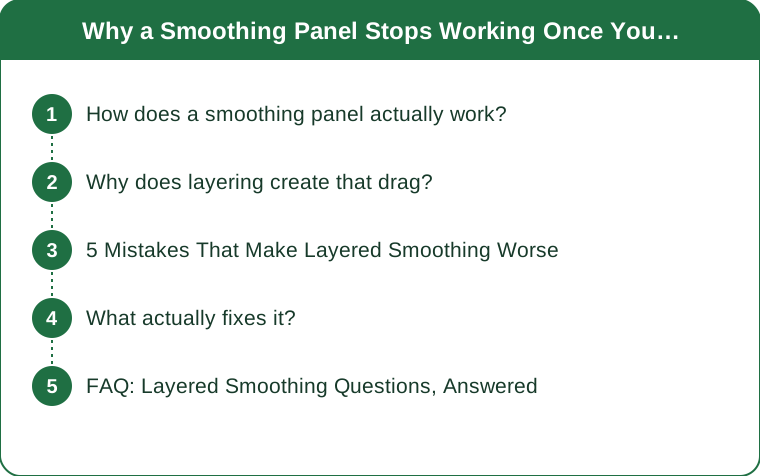
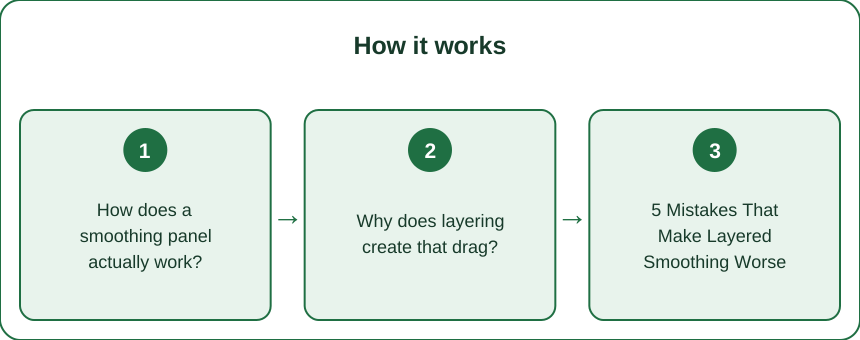
How does a smoothing panel actually work?
By spreading pressure, not by applying more of it.
A smoothing panel is typically a denser knit or a bonded section with higher elastane content. It holds a broad area at a consistent, moderate compression. Because the pressure is even across the whole surface, no single point stands out, and the result is a smooth line rather than a squeezed one.
Everything about that depends on the panel staying flat and staying put. It is engineered as a continuous surface.
The moment anything creates drag on part of that surface, the pressure stops being even. A section gets pulled downward or sideways, the fabric bunches minutely where it is being dragged, and the compression concentrates along the edge of the bunch.
A concentrated line of compression is precisely what a smoothing panel exists to prevent. So the failure mode is not the panel losing strength - it is the panel being pulled into exactly the shape it was designed to avoid.
This is why the problem appears suddenly with a change of clothes rather than gradually with wear.
Why does layering create that drag?
Friction, and autumn fabrics have far more of it than summer ones.
A smoothing legging in summer is usually under nothing, or under something light and smooth - a slip, a light dress, a technical top. Those surfaces slide over the panel freely and exert almost no drag.
Autumn layers are wool, cotton knit, jersey, corduroy, and lined skirts. All of them grip. A knit dress in particular has a textured surface that catches on the panel’s own texture, and every step you take drags the panel a fraction of an inch downward.
Over a few hours of walking, that fraction accumulates. The panel migrates down, its top edge rolls, and you get the line.
Weight compounds it. A heavy garment presses the two surfaces together, which increases friction, which increases drag. This is why a light summer dress causes no problem and a heavy autumn one does, even at the same length.
And there is a third factor: static. Dry indoor air makes synthetic panels cling to whatever is over them, which turns intermittent contact into continuous contact. That is why the problem often appears within a week of the heating going on.

5 Mistakes That Make Layered Smoothing Worse
1. Sizing the legging down to compensate. The most common response and the one that reliably backfires. A smaller panel has less surface area to distribute across, so the same drag produces a sharper line. Going a size up often works better than going down.
2. Choosing a panel that ends at the same height as the layer’s waistband. Two edges at the same level create a doubled ridge that shows through almost anything. Either the panel should extend well above the layer’s waistband or end well below it - never level with it.
3. Wearing the grippiest layer directly against the panel. A wool skirt straight onto a smoothing panel is the worst case. Anything smooth in between - a slip, a lining, a thin jersey layer - removes most of the drag for very little bulk.
4. Using fabric softener to reduce the cling. It does reduce static and it destroys the panel. Softener coats elastane fibres and permanently reduces recovery, which turns a fixable layering issue into a legging that no longer smooths anything.
5. Assuming the problem is the panel getting old. Genuine panel failure looks like loss of recovery after washing, visible slackness when the garment is off the body, and a gradual change over months. A sudden change that coincides with a change of outfit is mechanical, and it is fixable this afternoon.
What actually fixes it?
In order of how much difference they make.
Add a slip or lining layer. A thin, smooth layer between the panel and the grippy garment removes the drag almost entirely. A basic jersey slip is the cheapest fix available and it solves the problem completely for dresses and skirts.
Choose lined garments. Lined skirts and dresses already have the smooth layer built in, and they behave completely differently over a smoothing panel than unlined ones. This is worth checking before buying, and it is the reason two apparently similar skirts perform so differently.
Match the panel height to the outfit rather than the other way around. A full high-waist panel is right under a dress. Under a mid-rise skirt with its own waistband, a shorter panel that stops below the skirt’s band avoids the doubled edge entirely.
Deal with the static. Ten minutes hanging in a steamy bathroom before wearing, or a humidifier in the room, does more than any spray. Dry air is doing more of the work here than people credit.
Check silicone grip at the waistband. Many smoothing leggings have a silicone strip inside the top edge. That strip grips your skin and stops the legging migrating, and it is the single most useful feature for layering. If your current pair does not have one, that is a specific thing to look for in the next.
And wash correctly regardless: cold water, no softener, no tumble dryer. Heat is what genuinely kills a panel, and a panel killed by a dryer cannot be recovered by any of the above.
FAQ: Layered Smoothing Questions, Answered
Does this happen with all smoothing leggings or just cheap ones?
All of them, because the mechanism is friction rather than quality. Better ones resist it longer because denser knits migrate less and silicone waistbands hold position, but no panel is immune to a wool skirt sitting directly on it.
Should I wear shapewear under the leggings instead?
Usually not. Two compression layers create an edge where one ends and the other begins, and that edge shows more than either layer alone. One well-fitting smoothing legging outperforms two stacked garments.
Why is it worse when I sit down for a long time?
Sitting concentrates the pressure at the hip and holds the layer against the panel under load for an extended period. The drag that would take an hour of walking to accumulate happens in twenty minutes of sitting, which is why long car journeys and desk days are the worst cases.
TL;DR:
- Smoothing panels work by spreading pressure evenly, and anything that drags on them concentrates it into a line.
- Autumn layers - wool, knits, unlined skirts - grip far more than summer fabrics, and dry-air static makes it worse.
- Add a smooth slip between panel and layer, choose lined garments, and never let two waistband edges sit at the same height.
- Sizing down makes it worse; a silicone waistband strip helps more than anything else you can buy.
The panel has not given up. It is being dragged out of position by a jumper, and a two-ounce slip fixes what a new pair of leggings would not.
See It in Motion
Seen here: High Waist 8” Yoga Shorts — shop similar styles on bubblelime.com
Keep Reading
This article is for general informational and styling purposes only. Fit, sizing, and product availability may vary — check current details before purchasing.