Why a Smoothing Legging That Works Under a Dress Fails Under a Thin Knit
Quick Answer: A smoothing legging does not remove texture; it redistributes it. Under a structured or draped fabric that gap between skin and outer layer hides the transitions. A fine, clingy knit sits directly on the legging surface and reproduces every edge, seam, and pressure change on the outside. The variable is the outer fabric’s drape and surface contact, not the quality of the legging.
Judge a smoothing layer against the top you will actually wear over it, never on its own.

Why does the outer fabric decide the outcome?
Because clingy fabrics act as a contact print of whatever is underneath them.
A fabric that drapes, whether from weight, weave, or fibre content, hangs away from the body and only touches at a few points. The distance between the outer layer and the underlayer is what conceals transitions. A ponte dress or a mid weight jersey holds itself in its own shape, so it can pass over a hem or a seam without registering it.
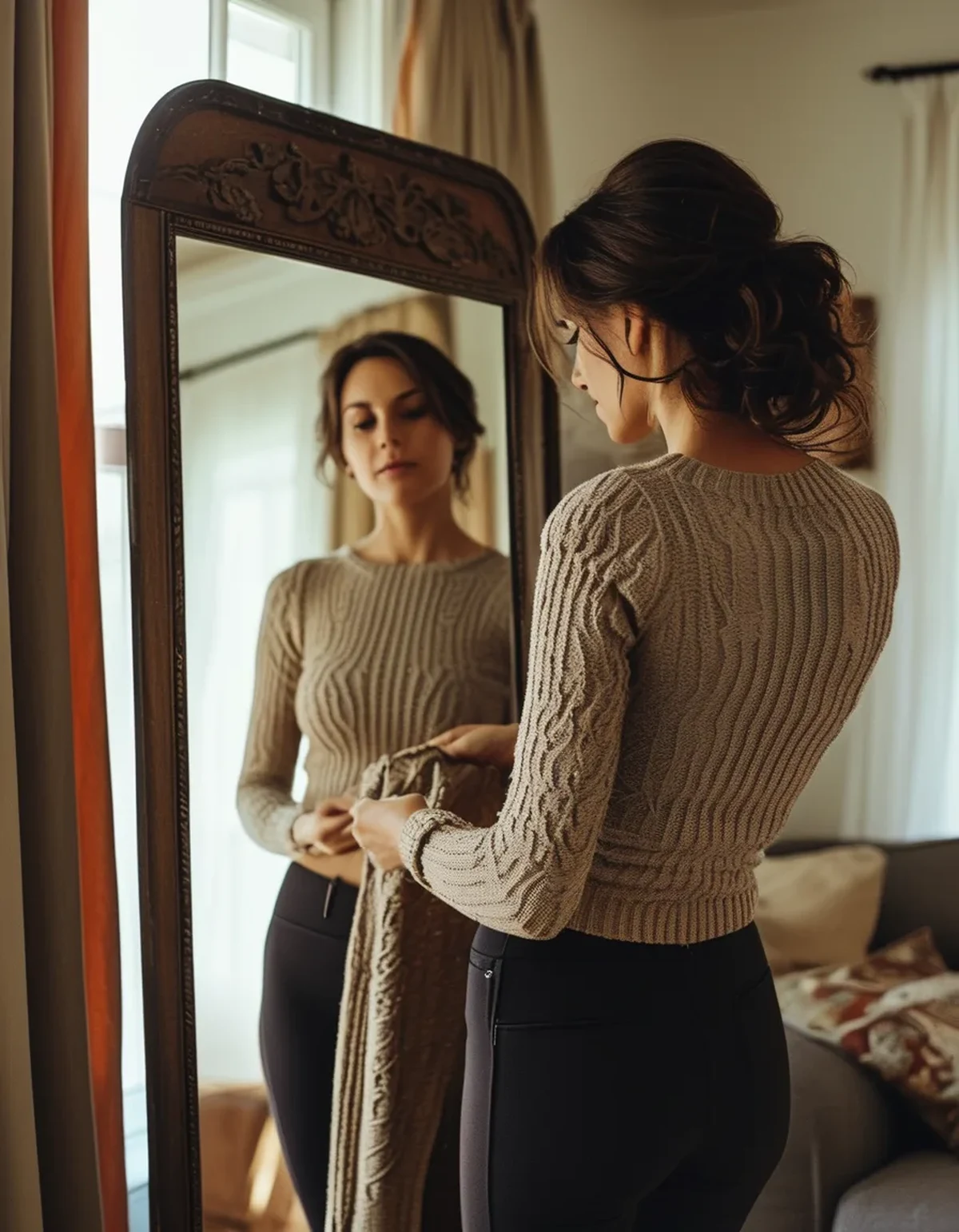
A fine knit does the opposite. A lightweight rib or a thin merino stretches slightly and follows the surface under it exactly, and any edge underneath appears on the outside as a line. This is a property of the outer fabric, and nothing about the legging changes it.
The transitions that show are predictable:
The hem or top edge of the smoothing panel, which is the sharpest change in thickness anywhere in the garment. A seam, particularly a flat locked one, which adds a few millimetres of stacked fabric. The waistband edge, for the same reason. And the boundary where compression stops, which changes the shape of the body underneath, not just the fabric over it.
There is a second effect worth knowing. Compression moves volume rather than removing it, so a firm panel that flattens one area displaces it to the boundary just above or below. Under a draping fabric this is invisible. Under a thin knit it is the most visible thing in the outfit.
So the same legging genuinely can be excellent and useless in the same week.
What should you look for in a layer meant for fine knits?
Different construction, not stronger compression. This is where most people go wrong, because more firmness makes the problem worse.
Bonded or laser cut edges rather than folded and stitched ones. A bonded edge is a fraction of the thickness of a hemmed one, and it is the single biggest factor in whether an edge shows through.
Seamless or minimal seam construction. Circular knitted pieces with no side seams remove entire lines from consideration. What seams remain should be flat and low profile rather than overlocked.
A gradual compression gradient. Look for a piece that eases off toward its edges rather than stopping. A firm panel with a defined boundary produces a visible ridge; a graduated one produces nothing to see.
Moderate rather than maximum firmness. Higher compression displaces more volume to the boundary and creates a harder edge everywhere it stops. Under thin fabric, a lighter smoothing layer usually looks better than a stronger one, which is genuinely counterintuitive.
Length that finishes past the hem of the outer garment, or well short of it. The one place an edge cannot hide is directly under the visible part of a fitted knit. Full length under a midi, or ending clearly above where the fabric starts to cling.
Matte surface, not a shiny finish. Sheen shows through pale and fine fabrics, particularly in the flat overhead lighting of an office or a shop.
Colour matters more than expected too. Match the layer to your skin tone rather than to the outer garment for pale and light coloured knits, because a dark layer reads through a light fine knit as a shadow even when nothing else shows.
What Nobody Tells You About Smoothing Layers
Firmer is not smoother. The instinct to size down or go stronger produces harder edges and more displacement. The best result under fine fabric usually comes from the gentlest layer that still does the job.
Sitting is where it changes. Compression garments shift when you sit and fold, and an edge that was invisible standing in the bedroom will have migrated by the time you stand up from a two hour meeting. Any assessment done only standing is incomplete.
Warm fabric behaves differently from cool fabric. Both layers are more relaxed after twenty minutes of body heat than they were in a cool room, which is why a combination that looked perfect at eight in the morning can look different by eleven.
Static is the hidden autumn problem. As indoor air dries out with heating, fine knits cling to a synthetic layer underneath far more than they did in humid summer air. The same two garments that worked together in July can be unwearable in October, and nothing about either has changed except the humidity.
Overhead lighting reveals everything side lighting hides. Shop fitting rooms and offices are lit from directly above, which throws small ridges into relief. Judge in the lighting you will be in, not in bedroom lamplight.
Nobody is looking as closely as you are. Worth saying. The visible difference between a good and a merely acceptable combination is far smaller from four feet away than it is in a mirror at arm’s length.
How do you test a combination before you rely on it?
Together, seated, and in the right light. Three minutes, and it prevents the version of this discovery that happens in an office at nine thirty in the morning.
Test the pair, never the piece. The legging alone tells you nothing. Put on the exact knit you plan to wear, or the closest thing you own to it, before deciding anything.
Stand under overhead light and look from the side. Front on is the most forgiving angle and the least informative. The side profile is where edges and hems appear, and it is the angle other people mostly see.
Sit down for two full minutes, then stand and look again. This catches migration, rolling, and the way the panel redistributes when folded. It is the check that separates a combination that works from one that works for an hour.
Walk a few steps and check the back. Movement finds the edges that a static check misses, particularly at the top of the thigh.
Run a hand over the outside. If you can feel the edge through the outer fabric, it will show under stronger lighting than you are currently in, even if you cannot see it yet.
And factor in the season, because right now the wardrobe is changing under you. Fine knits, thin merino, and clingy long sleeved layers come back in exactly the weeks when tights and smoothing layers do, so combinations that were never tested together in summer are suddenly the daily uniform. Two things follow: run the check on your autumn knits now rather than discovering the problem in a fortnight, and expect static to be a bigger factor than it was, which a conditioner rinse or an anti static spray largely resolves.
One more practical point. If a combination only works when you are standing still in good lighting, it does not work. There is usually another layer in the drawer that does.
FAQ: Smoothing Layer Questions, Answered
Why do the edges show more in some tops than others?
Because drape and cling vary enormously between fabrics. Anything fine, stretchy, and light weight follows the surface underneath it; anything with weight or structure bridges over it. The legging is the same in both cases.
Should I size down for more smoothing?
No. Sizing down increases compression, which displaces more volume to the panel edges and creates a harder line, and it usually makes rolling worse. Correct size, gentler garment, better edge construction.
What length works best under a fitted knit dress?
Either full length, or ending well above the point where the dress starts to cling. The one thing to avoid is a hem sitting in the middle of the fitted section.
How do I stop a fine knit clinging to the layer underneath?
It is static, and it gets worse as indoor air dries out in autumn. A fabric conditioner rinse, an anti static spray, or a natural fibre layer between the two all reduce it noticeably.
TL;DR:
- Fine, clingy knits reproduce every edge underneath them, while structured and draped fabrics hide the same edges completely.
- Look for bonded edges, minimal seams, and a compression gradient rather than a firmer garment.
- More compression makes edges worse, not better, because it displaces volume to a defined boundary.
- Test the pair together, seated, under overhead light, and expect static to become a factor as indoor air dries out.
Before you build an autumn outfit around a fine knit, sit down in it for two minutes and then look in the mirror. That is the whole test.
See It in Motion
Seen here: High Waist 8” Yoga Shorts — shop similar styles on bubblelime.com
Keep Reading
This article is for general informational and styling purposes only. Fit, sizing, and product availability may vary — check current details before purchasing.