Do Smoothing Leggings Actually Change Your Posture?
Quick Answer: Yes, but through feedback rather than force. A firm high-waisted band does not physically hold your spine anywhere — the fabric is nowhere near strong enough. What it does is increase sensory awareness of your trunk position, which makes you self-correct more often. The effect is real, small, and disappears when you take them off, which is either fine or a problem depending on what you expected.
You put them on and stand a little taller. That is not imagination, and it is also not the leggings doing the standing.

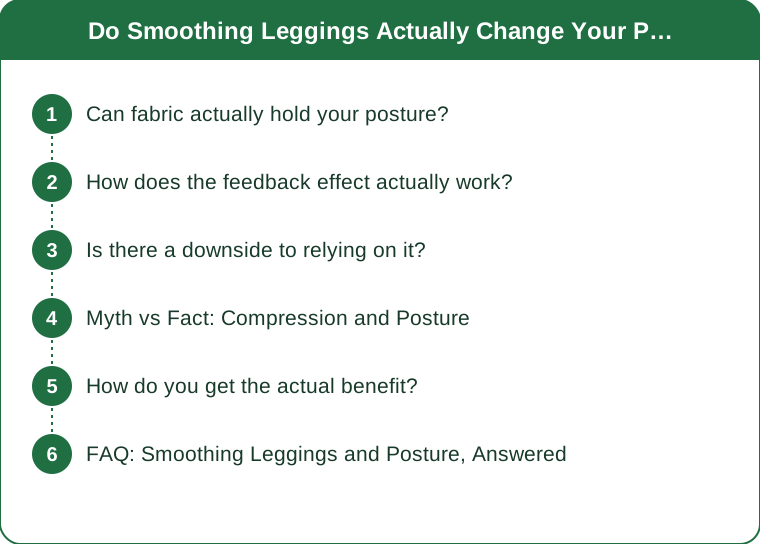
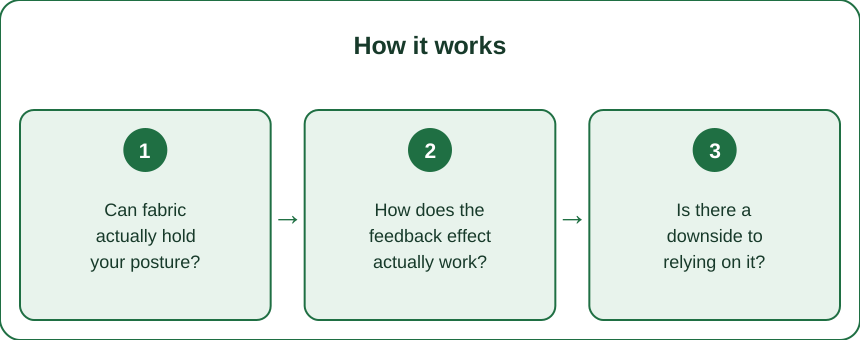
Can fabric actually hold your posture?
No, and the numbers make this clear quickly.
Holding a spine in a position against the load of your own upper body requires force in the range that braces and orthotics are engineered to produce — rigid or semi-rigid structures with specific pressure points. A knit fabric with 20–30% elastane produces a few millimeters of mercury of compression, which is a fraction of what would be needed to change skeletal position.
You can test this yourself in about five seconds. Put on your firmest high-waisted leggings and deliberately slouch. Nothing stops you. The fabric does not resist, does not pull you back, does not make slouching harder in any mechanical sense.
What the fabric does produce is surface pressure and stretch across the skin of your abdomen and lower back — and that is a sensory signal, not a structural one.
This distinction matters because it changes what you should expect. A brace works whether or not you are paying attention. Feedback only works when some part of you notices. Everything real about the posture effect of smoothing leggings runs through that noticing.
How does the feedback effect actually work?
Through proprioception — your sense of where your body is in space.
Proprioception comes from receptors in muscles, joints, and skin. Skin stretch is a genuine and well-documented input: when the fabric across your lower back stretches as you slouch, the receptors in that skin fire differently than they did when you were upright.
That gives your nervous system a clearer signal about trunk position than it usually has. Most people’s awareness of their own spinal position is surprisingly poor, especially after two hours at a desk when everything has drifted without any conscious decision. A firm waistband makes the drift noticeable.
The result is more frequent self-correction. Not continuous correction — you still slouch — but you catch it sooner and more often. Over a full day, that adds up to meaningfully more time spent in a better position, achieved entirely by you.
There is a second, softer effect worth naming honestly: the way clothes make you feel changes how you carry yourself. This is not a compression mechanism at all, but it is real and it is part of why people notice the difference. It also explains why the effect is strongest in the first hour and after you catch your reflection.
The important asterisk: habituation. Your nervous system adapts to constant stimuli. After a few hours, the waistband stops being novel, the signal fades, and the correction frequency drops back toward baseline. This is the same mechanism that makes you stop noticing a watch.
Is there a downside to relying on it?
There is a theoretical one that gets overstated, and a practical one that is worth taking seriously.
The overstated concern: that wearing compression weakens your core because the fabric does the work. For the level of compression in ordinary smoothing activewear, this is not plausible — the fabric is not producing enough force to unload anything. Genuine disuse would require actual mechanical support, which this is not. You are not going to atrophy from leggings.
The practical concern is different and more real: the effect is entirely external, so it does nothing on the days you are not wearing them. If your only posture strategy is a garment, you have a strategy that works about four hours a day, five days a week, and vanishes on vacation.
There is also a fit failure mode worth flagging. Compression that is too tight around the waist can restrict full diaphragmatic breathing, and shallow breathing tends to produce more upper-chest and shoulder tension, which is the opposite of what you want. If you find yourself breathing higher in your chest, or if you unconsciously hold your stomach in while wearing them, the garment is working against you.
A quick self-check: sit down, put a hand on your lower ribs, and take a slow breath. You should feel the ribs widen sideways. If the waistband prevents that, size up or choose a softer compression.

Myth vs Fact: Compression and Posture
Myth: High-waisted leggings support your lower back like a lifting belt. Fact: A lifting belt works by giving your abdominal muscles something to brace against, generating intra-abdominal pressure that stabilizes the spine — and it requires you to actively push out against it. A legging waistband is passive and produces a tiny fraction of the pressure. The mechanisms are not comparable.
Myth: Tighter means better posture feedback. Fact: There is a curve, and it turns over. Some tension is needed to produce a clear signal, but past a point the sensation becomes constant and uniform rather than position-dependent, which makes it less informative rather than more. Very tight garments also habituate faster because the stimulus never varies.
Myth: The effect stays after you stop wearing them. Fact: Not on its own. The feedback creates more correction reps, and reps can build a habit — but only if you are consciously involved. Passive wearing produces no carryover once the garment comes off.
Myth: Posture leggings are a different product from smoothing leggings. Fact: Almost always the same garment with different marketing. The construction that produces smoothing — firm knit, high rise, wide band — is the construction that produces the sensory feedback. There is no separate posture technology in most of these.
Myth: If your back feels better in them, that proves it is supporting you. Fact: It might mean you moved better because you were more aware, which is a genuinely good outcome. It might also mean the warmth is helping, which is a real and underrated effect of a compressive layer over the lower back.
How do you get the actual benefit?
Treat the garment as a reminder system and put something behind it.
Use the sensation as a cue, not a solution. The moment you notice the waistband stretching across your lower back, that is the reminder. Reset your position then. The garment cannot make you do this, but it can make you notice more often, and noticing is the scarce resource.
Pair it with an actual position. When you reset, the target is: ribs stacked over pelvis, weight through your heels and midfoot rather than pushed forward, shoulders back and down without forcing your chest up. Practicing the same reset repeatedly is what eventually becomes automatic.
Do not size down chasing more effect. More compression does not mean more benefit, and it costs you breathing room and comfort. The right fit is firm and even, with no digging and no rolling.
Build the thing that works without them. Nothing replaces actual capacity. Hip flexor mobility, thoracic extension, and posterior chain strength are what let you hold a position without effort — three sets of eight of anything hinge-based, twice a week, does more for your posture in a month than any garment does.
Watch how long the effect lasts on you. For most people the useful window is the first two to three hours. If you want the cue back after that, changing position — standing up, walking, sitting differently — re-varies the stretch and re-establishes the signal.
FAQ: Smoothing Leggings and Posture, Answered
Are they useful for a desk job?
Yes, in a modest and honest way. They increase how often you notice that you have collapsed forward, which over eight hours is worth something. They do not fix a bad chair, a low monitor, or eight uninterrupted hours of sitting, and those are much larger factors.
Should I wear them if I have actual back pain?
Many people find a compressive layer over the lower back comfortable, partly from warmth and partly from the sensory input, and there is nothing wrong with using that. But ongoing back pain deserves a proper assessment rather than a garment, and if pain is persistent, worsening, or accompanied by numbness or leg symptoms, see a professional. This is general information, not medical advice.
Do compression tops do the same for upper back posture?
Somewhat, and the mechanism is identical — skin stretch feedback across the shoulder blades when you round forward. The same limitations apply: it is a cue rather than support, it habituates, and it does nothing for the thoracic mobility that usually determines whether an upright position is even available to you.
TL;DR:
- Smoothing leggings cannot hold your spine — the fabric produces a fraction of the force that would require
- They increase skin-stretch feedback, so you notice drifting and self-correct more often
- The effect habituates within a few hours and disappears entirely when you take them off
- Too much compression restricts diaphragmatic breathing, which works against you — check that your lower ribs can widen
Useful as a reminder, useless as a substitute. The leggings can tell you that you have slumped; the standing back up is still entirely on you.
See It in Motion
Seen here: High Waist Yoga Leggings with Inner Pocket — shop it on bubblelime.com
Keep Reading
This article is for general informational and styling purposes only. Fit, sizing, and product availability may vary — check current details before purchasing.